
I’m Terry Carroll
a photographer and novelist
in Oakland, California
-
Holiday at Kilkee – County Clare, Ireland, August 2012 I am a photographer and a novelist. I produce my work through Oakland House Press, of which I’m the publisher. It’s a solo venture — more about creating than selling — so the publishing part is more about making books than finding markets for them. However, if you’ve found yourself here, Welcome! (Let me give you a book : ) This website provides an overview of my best creative output, circa 1975 — 2023.
I can be reached via the usual formulation of my first name at this website’s name. I’d love to hear from you.
. . .
But first, a quick look at my photography:
*
Photography, Writing, and Design
Photography is my top strength. Writing is my where I’ve been most ambitious — educationally and professionally. And design is my auxiliary skill, functioning to facilitate. Though my natural talent is with a camera.
My style and technique as a photographer came into form quickly, starting as a ninth grader at Alhambra High School in Martinez, California, in the Autumn of 1974. (That’s also when I got serious about writing, but I’ll get to that later.) My photography just has a natural “pop” to it. It is alive and lively, with humanity and information and artistry. And the older I get, the more tickled I’ve become of that ability I’ve possessed. I came to my style and technique by way of emulating photojournalists, whose work I’ve followed since I was a kid. I learned how they did it, then I applied that method to my everyday life.
I’m not a set-up or pose photographer. I shoot stuff as it’s happening. I have quick skill with a camera in composition and timing, working close, working unobtrusively — generally as part of the scene — and capturing small moments, impeccably timed, that are true to the subject. There is a small bubble of empathy and trust that I seem to find when photographing people. So I treat all whom I photograph — no matter how brief the encounter — as clients. And yet those moments are often humorous, but we are in it together (including you, the viewer). So my photos are emotionally warm, though also (hopefully) not saccharine. A lot of my photos are outright nutty. And there’s a beauty and a design quality to many of my pictures, even though I mostly shoot in an almost snapshot style. That’s my sense of design coming through. More about that later, but the effect often has a “movie-still” quality. I just simply frame things well and feel the moment as it’s coming … and I hit on the beat. And then it looks like a scene from a movie.
Having been photographing for five decades, I’ve got a remarkably deep archive of images. It comprises the mid-1970s to the mid-2020s, all of (mostly) normal people in various version of everyday life, and from a lot of different places where normal everyday people can be found.
I believe my photography is best presented in book form, or at least that’s my preference. Photo books bring together my three talents and/or skills by way of titling, pairing, pacing, and presenting. The pairing & pacing aspect of my books is the key to their being books and why I feel so strongly for the the book-form presentation of my images. I don’t deliver my photos in any sort of chronology or geography or other such thematic groupings. Rather, I pair my images in terms of their emotional and compositional components, and then pace the pairings through the pages to form waves mood and attitude. The same sort of ambiguity resides in my titles, the best of which are precise summations of content not obvious, intended to act as frames, not as catalog descriptions. So that, along with the pairings and pacing, my titling gives my photography monographs a literary quality to them, as though collections of stories or poetry. That is by intent. As for presentation, I keep my graphic design simple and classical and uniform, providing a package that serves the content.
I created that template of presentation with my first book, Relationships, in 2008. Then, fifteen years later, I began work on a three-book project in order to have a “four-square” collection to fully represent my archive — knowing that my active years as a photographer was waning. (Multiple reasons were behind the wane, but basically I came to feel I’d done what I set out to do in my nearly 50 years as a photographer; time to write the novels I’ve been promising my teenage self.) So I treated this last project as my “senior thesis” in photography. Producing a trio of monographs simultaneously was partly for economics, but also to better coordinate my books as a cohesive and comprehensive presentation.
When I published them in late 2023, I then had myself a tidy quartet: Relationships, Readings, Exhibitions, and Discoveries. All are 9 x 12-inch (horizontal) hardbacks, produced in a traditional “art book” manner, using off-set printing on lustre paper, stitch-bound for longevity. And, of course, all of my photos are in black-and-white, presented on the page with a rich “duotone” span of grays.
*

RELATIONSHIPS (2008) was my first book, a monograph of 137 images across my archive from 1975 through 2007. With this book, I set out a “bold stance,” which is that really good photos can also be fun and loving. That has been the philosophy guiding my photography, the aesthetic I apply to the page. And it’s a serious one. I make serious art. (I really do!) It is driven by the daring notion that most people are actually good in their present state of being (aren’t you?). As such, capturing that goodness is, in fact, capturing Truth — especially if it’s done well. It’s the doing it well that’s the hard part. It’s all in the timing and composition and the context and setting. To that end, I feel that this book succeeds in its assignment. (And I’ll fight you if you disagree!) (Kidding!) (… Not.) Regardless, it’s a fun, sweet, well-produced book, and I’m really fucking happy with it!
Hardback; 137 black-and-white photos in 144 pages; printed by Stinehour Press of Vermont; stitch-bound by by Roswell Bindery of Phoenix, Arizona; limited edition: 750 copies; each signed and numbered. $35 retail (Oakland House Press, 2008). ISBN: 978-0-9773770-6-0. Now out of print, but available in the used marketplace … and from a stash I’ve set aside. Email me and I’ll send you a copy.
*

READINGS is my quiet book. It seeks to remain respectable and tender. Generally, it is a book of portraiture — mostly un-posed, mostly hand-held, and pretty much always flattering. Funny how flattering the state of quiet is. So, of course, there is a great deal of day-to-day beauty in this book. It features a lot of friends and people I care for — including strangers — being comfortable, calm, and beautiful. Though, as always, there is some silliness spilling out. (I can’t help it.) Altogether, it is a lovely and uplifting book.
A video presentation of READINGS can be seen here.
Hardback; 137 black-and-white photos in 144 pages; printed by Brown Printing of Portland, Oregon; stitch-bound by by Roswell Bindery of Phoenix, Arizona; limited edition: 400 copies; each signed and numbered. $50 retail (Oakland House Press, 2023). ISBN: 978-0-9773770-6-0. Email me and I’ll give you one.
*

EXHIBITIONS is my loud book. It’s full of extroverts and people in moments of performance — intended or not. It’s a good, raucous look at situations and comedies … and a few flashes of anger, though no violence. Mostly, the stuff in this book falls on the “nice side of loud.” There is a lot of fun on display, for sure.
A video presentation of EXHIBITIONS can be seen here.
Hardback; 137 black-and-white photos in 144 pages; printed by Brown Printing of Portland, Oregon; stitch-bound by by Roswell Bindery of Phoenix, Arizona; limited edition: 400 copies; each signed and numbered.$50 retail (Oakland House Press, 2023). ISBN: 978-0-9773770-7-7. Email me and I’ll give you one.
*

DISCOVERIES is my radical book. It features no people! For me, this book itself was discovery. It hadn’t even occurred to me that I had such a collection of images in my people-focused archive. The book began as a small excursion, guided by a question I had of my pictures: What is my photography without people? Almost as soon as I asked it, there they were! Sprinkled throughout my archive were intriguing and beautiful captures of “scenes and things,” taken along the way, mostly as snapshots, in my style (including some humor — but with no people), as well as some more deliberate tripod-based photos, indoors and out. Altogether, I was surprised and pleased by my discovery of DISCOVERIES. In putting together the book, I treated it as though it were a long poem of short vignettes, in the form of mostly quiet black-and-white photos.
Hardback; 137 black-and-white photos in 144 pages; printed by Brown Printing of Portland, Oregon; stitch-bound by by Roswell Bindery of Phoenix, Arizona; limited edition: 400 copies; each signed and numbered. $50 retail (Oakland House Press, 2023). ISBN: 978-0-9773770-4-6. Email me and I’ll send you one.
*
MY WRITING
As someone with natural camera skills, I’ve got to say that writing is a lot harder than it looks. My desire to be a good writer goes back to about fifth grade. By the time I hit ninth grade, as a fourteen-year-old in 1974, I was certain my future would be as a writer. Entering college, I actually “gave up” photography to focus on writing, language, and literature. Words on paper were a lot cheaper than photographs on film, and it felt more important — because it was harder. My degree was in creative writing (San Francisco State, 1982), but I also studied across the scope of schooling, with a lot of science, history, linguistics, statistics, art history, and dance. (Dance and drumming is where I get my camera skills; it’s all in the rhythm.) Quite unlike my photography, I don’t have any early- or even middle-era writing that I would still proudly show. But I’ve kept at it, finding myself in the lives of characters and settings, coming to understand the timing and tempo of scenes. The process of writing character- and dialogue-driven narrative now feels like it is directed by my sense of photography. The movie stills of my photography are now movies-in-text by way of novel writing. Funny how two forms inform the other.
Below are my two primary works of writing, both of which I produced in my forties and fifties.
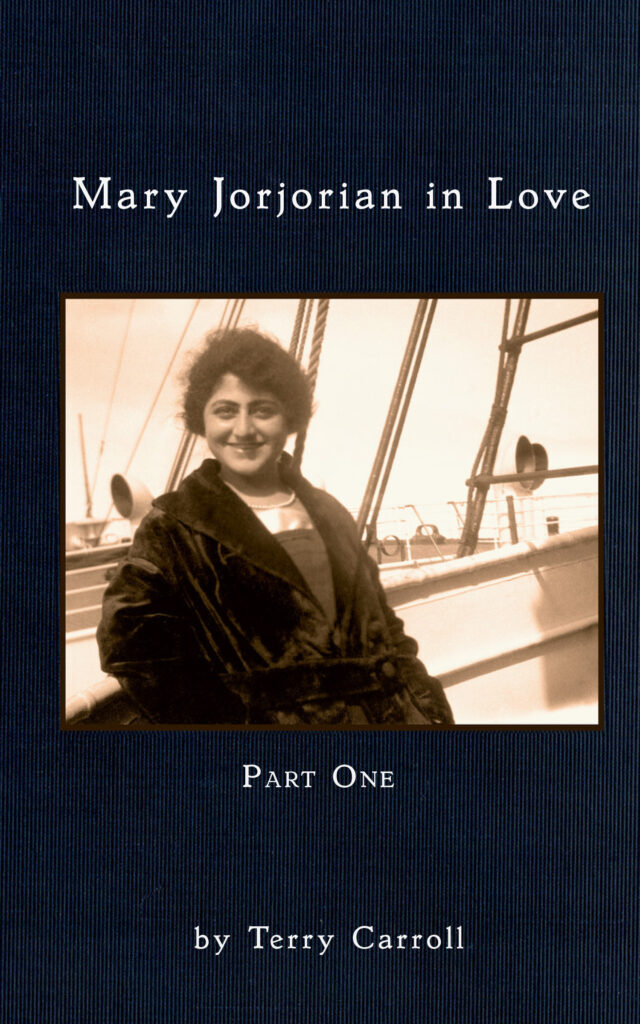
Mary Jorjorian in Love, Part One (2014; 2022) is a complete novel, though it is intended as the first of a five-part series. (Parts 2 – 5 are in the works.) (“Still?!” Yes, sorry.) Meanwhile, regardless of parts not yet completed, this one does work as a complete, self-contained novel, and I am very pleased with it — even though (or especially because of) it ends without a full conclusion, just like real life. Mary is wonderful character. When we find her she is twenty-years old in the spring of 1921: bright, optimistic, impassioned, educated, and talented. Oh, and vulnerable and emotional! (She’s twenty.) Mary’s an Armenian immigrant, having arrived in New York as a one-year-old aboard ship from the Ottoman empire. Being nine years younger than her sister, Agnes, it was Agnes who taught Mary English — while Agnes herself was learning it. So, really, Mary’s an American girl. And as a girl in New York City, she earned a great public education (including graduating from Wadleigh High School, possibly the top girls public high school in the nation at the time), where she flourished intellectually. And now, in the spring of 1921, Mary is living with Agnes again — but in Jacksonville, Florida, along with Agnes’s husband, Peter Kludjian, and their four-year-old son, Bedros, as well as their newest boy, baby Shavarsh. Also living with them is an old friend of Agnes and Peter’s, Daniel Eliseian. Daniel is a twenty-six-year-old tailor and violinists, who is handsome and courteous and worldly and tender and talented. He’s only been in America for six years, and he had felt ill-prepared for Agnes Kludjian’s little sister moving in with them. However, as we meet them, with four months in the household together, Mary and Daniel have reached a turning point — or multiple turning points: They’ve each suddenly found themselves in love — though with complications (some unspoken and some unseen). And so we begin the month of March with them, in the present tense, 1921. Here it comes, the door opens ….
Mary Jorjorian in Love is based on the diaries and letters (and photographs and gramophone records) of my wife’s maternal grandmother, Mary Jorjorian. Elderly Mary had packed them all away carefully in the months before her death at age 79. Then, thirty years later, during a Mother’s Day attic cleaning for my mother-in-law — Mary’s daughter, Violet — that box was opened for its first time since 1979! “What have we here?”: My goodness, it’s a vibrant young woman from early in the 20th century! Young Mary jumped from the box by way of her own curated documentation. And “young Mary” was the Mary no living family member had ever known. (Mary in her middle and elderly years had had serious mental health problems, beginning with what we now know as post-partum depression — following the birth of her fourth child, Violet, no less. My wife, a grand-daughter, had known Grandma Mary through her last 19 years of life … as an almost mute person, very flat, not fully present.) So that box of “primary source materials” was an astonishing and inspirational find, which brought my now-late mother-in-law, Violet, to assign me to turn it into a novel before she herself was gone. (Thanks, Violet! We finished in plenty of time! You can rest in peace.) This then is a novel that uses the basic outline and many details of Mary’s own self-documentation in an attempt to breathe plausible life into them — fleshing it out with setting and dialogue and action and love and romance, presented in a “you are there” present tense. I feel that I’ve succeeded (and so did Violet, prior to her own death in 2019 — thirty years after her mother), because I find myself crying whenever I re-read it (especially Chapter Three!). Get out your hankies, and enjoy a heart-breaking love story … based on an actual life-fulfilling love story.
(Oakland House Press, 2014; revised 2021)
Not readily available; other volumes are in the works. Email me and I will send you a PDF.
*

Among the Fourth Graders is a novel of a year-in-the-life of a fourth grade classroom in San Francisco, circa 2000–2005, told in present-tense by its protagonist, me, the 41-year-old male pothead classroom assistant, Terry Carroll. Hi, good to meet you.
The novel is based on my six years as a volunteer with fourth graders, mostly at one San Francisco elementary school, packaged into a fictionalized setting and story arc. To do it, I took the granular details of my experiences across those six years and formulated a “best of” class of characters and incidents into a “fictional” single school year. The model for that “single year” was my actual first full year as a volunteer, assigned to a brand-new, naturally talented teacher — so that everything in this book is interesting, fun, horrifying, tragic, brilliant, stupid, glorious, hilarious, touching, and deeply, deeply loving. This is a laugh-and-cry book, filled with lots of foibles by its narrator (Hello!) and a cast of very good and interesting nine year olds who have a lot to teach.
Following two years of drafting, I created the working version of the book by way of weekly installments on Facebook, starting in August 2011, and finishing that May — thus following, week-by-week, an actual school year. With that kind of “public pressure” (I had more than 100 followers!), I was amazed by how productive I could be. It really got my book into shape, and I published it in final form a year later. My first novel!
Hardback and paperback, 386 pages (Oakland House Press, 2012). Alas, it has run out of its first run, and it needs some revisions before a second run. But I do have a stash, so email me and I’ll send you a copy or PDF.
*
*
NON-SALES PITCH:
I don’t have much commercial instinct or drive, and yet I want my creative work to exist outside my home: outside the internet, in book form, but also outside of the cartons in my basement, to be seen or read by people.
I made my books so that I could give them away. I don’t have a “name” as a photographer or writer, no agent, no publisher (not a real one). No one knows to look for my work, but I always get really positive response, and I’m confident you’re going to like them!
Want a book? Even if you’re just curious, I’ll send you one. I’ll send you as many as you want. No obligation. You won’t have me following up, “Liked it? Tell me about it!” Nevertheless, my photo books in particular make great gifts. Want some books as gifts? No cost to you. Drop me a line, and I will send you what you desire.
And of course, the way to get a hold of me is my first name at my website’s name. I welcome all inquiries.
(Whew! Just that one segment of “not selling” wore me out. How do self-promoters do it?)
*
LONG TERM AND PROJECTS:
Spoiler Alert: The reporting below contains oodles of plot give-aways, detailing issues, failures, and resolutions experienced by the characters being written about. Please stop here if you don’t like reading such things.
Mary Jorjorian in Love, Parts 2, 3, 4, & 5: When we last left Mary, she was boarding ship in Jacksonville, Florida, for New York City … and I was struggling with completing its follow-up second novel in the series. The New York portion is exciting and important to the foundational aspect of the series (because Mary grew up in New York), but I’ve also encountered great gaps in the documentary materials left by Mary, and some difficult-to-decipher abbreviated “notes” that she took — in contrast to her detailed Florida diary. (Mary was having too much fun back in her hometown Manhattan!) So I need to make some fundamental decisions of non-fiction vs. fiction — which is always a problem with fact-based dramas as it regards filling in blanks and/or streamlining story arcs. My “Mary series” is, of course, based on the documented romance of my wife’s maternal grandmother. The basic outline is this:
Book One: Mary Jorjorian falls in love with Daniel Eliseian in Jacksonville, Florida, on March 1, 1921 — the day she commences her diary. She and Daniels are both transplanted immigrants by way of New York, but Mary had arrived at Ellis Island as a baby in 1901; whereas Daniel was a more recent arrival to America (via Buenos Aries, by way of Marseilles.) There’s is a shared yet unspoken love between them that tragically comes — physically — to an end (before they can actually verbally state their true feelings — let alone kiss!) with Daniel’s sudden departure and his unexpected return to Buenos Aires, for reasons almost out of his control. And yet his move only deepens each of Mary’s and Daniel’s love for each other — though still unspoken! Meanwhile, Mary is utterly distraught. She finds assurance from family and friends (though one “friend” of Daniel’s also plays the role of an opportunistic a cad), while she sees her long life ahead shrinking, having missed the perfect love of her life, possibly forever. For the remaining month of March 1921, Mary is falling deeper in love the more she recalls their time together. She imagines what her life would be like with him had he remained, forming touching vignettes in the book’s 5-week narrative. During her remaining time in Jacksonville, she goes to movies and reads books (presenting for the reader a contemporaneous experience of 1920s popular culture), all the while she is in a constant churn of speculation. The book ends with Mary’s departure from Jacksonville on April 4, 1921 (coincidentally Daniel’s 27th birthday), returning to her hometown of New York City. She is heartbroken and seemingly defeated in what she had seen as her life’s one true opportunity. (They really were a great potential couple!) As such a good character — now heart-broken — Mary makes you want to come along, just to tell her everything’s going to work out.
Book Two: Mary is back in New York City, living with her elderly aunt (her father’s older sister) and uncle in the Armenian enclave of the “lower east twenties” of Manhattan. Meanwhile, Mary’s nuclear family (Dad, Mom, and her four younger siblings) now live in Fresno, California. It had been their father’s dream for a “new Armenia in America,” moving there in early 1920, with the children leaving behind their entire world as they’d known it as native New Yorkers. (And Fresno is where Mary had lived for a few miserable months prior to her time in Florida with her older sister). But now Mary is back in New York, where she pines for Daniel (who has gone “silent” in Buenos Aires), yet she also reconnects with old friends and cousins, gets her old job back as a teletypist at Western Union, consumes city and family culture, and — to her chagrin — finds herself considered “available” within the tight New York Armenian community. This produces difficulty when one of the gentle, quiet suitors is a young (24-year-old), earnest, hardworking, capable, and ambitious Armenian fruit vendor — named Dikran Mosgaffian — who lives with his parents in the same building as Mary’s aunt and uncle. Dikran can’t help but show his interest, nor can Mary’s aunt and uncle and Dikran’s parents not resist urgent eagerness for the pair. Meanwhile, Mary certainly appreciates Dikran’s many nice qualities, yet those are not reasons for marriage. After all: Daniel plays the violin, and is a tailor of high artistic skill, who knows six languages, and who has a mustache that’s under control! So Mary breaks poor Dikran’s heart, and she disappoints her community (… yet she has still has not heard from Daniel!). Meanwhile, Mary’s best friend, Anna Abajian, now out of conservatory (a precursor to Julliard), is suddenly finding work as pianist (as an instructor)) — under the tutelage of none other than Leo Ornstein (Really. See his Wikipedia page.) Mary can’t help but feel envy of Anna and, in turn, slip into depression. Meanwhile, her aunt and uncle are driving her mad. Then, in August, Mary’s big sister, Agnes, and her two young sons — Bedros and Shavarsh — arrive for an extended stay — as a waylay, while her husband Peter gets matters settled for their move to Chicago. Reluctantly, Mary decides to take Agnes’ invitation and move there with them. After all, Chicago is a young vibrant city, which might offer a new start for Mary (and out of her aunt and uncle’s apartment). At the same time, Mary finally hears from Daniel, by way of Agnes, and the possibilities of a bright future begin anew ….
Book Three: “This isn’t Chicago! You said ‘Chicago.’ This is Des Moines!“— Mary retorts to her brother-in-law, Peter, in one of their first new fights, living together again — now in Des Moines!, not Chicago, as Peter had promised. Well, things had fallen through with the Jorjorian cousins, whom Peter Kludjian was set to work for, selling oriental carpets in Evanston (a nice suburb of Chicago). Instead, they’re now living in Des Moines! — in a small apartment in a small building, with a mean landlady, and with Peter working in a department store! — not a specialty rug shop. So Peter feels demoralized and takes it out on the women and children in his Iowa home. Soon enough, though, Peter and Agnes do buy a house, and that helps. But Mary is still stuck in Des Moines! It’s a small city with no Armenians, no sophistication, and not many employment opportunities for a well-educated young with dreams — plus, no Daniel! And yet … Daniel is back in Mary’s life. Since the end of her New York stay, Mary and Danial have been in long-distance correspondence. Very quickly, after initial tentative formality, they have revealed to each other their hidden love. (!) Mutually ecstatic, their letters quickly ascend to Daniel’s marriage proposal to Mary! Yet … still no Daniel — only lots of excuses for his delay (all “valid,” but nevertheless difficult to understand). Regardless, Daniel may return to New York and probably Chicago, but he will never come to Des Moines — and Mary knows that. In the meantime, brother-in-law Peter makes life so miserable for Mary that she decides to return to Fresno — Fresno! — a place that had nearly crushed her soul a year earlier. The return comes on the urging of her parents, who, along with Mary’s four younger siblings, are overwhelmed with their new lives as fruit farmers … and could use her help. Mary sees no alternative. She is so close to marriage, yet so distant from stability.
Book Four: Fresno. Oh, Fresno. Mary had lived here before (in the California’s Central Valley heartland), having moved from New York City with her family in January 1920, after her father acquired the property not even in Fresno, but in the nearby small farming town of Clovis, California. To an orchard and vineyard … in the first month of Prohibition. (It turns out that that was why Dad got the property for so cheap!) Farm life had exhausted and suffocated city-girl Mary after only a few months that first time around. Now Mary is back, and the farm and her father are as maddening as ever. Mary gets a job in town with Western Union (her New York employer) to help with income, leaving most of the physical labor to her younger siblings. Her next younger sister, Sara, is a brilliant girl — more-so even than Mary had been — but the move to small town Clovis has been traumatic for her. Sara had been a star student in her junior year at Wadleigh High School in Manhattan (Mary’s alma matre and one of the most advanced high schools in the nation) before she was forced to enter mid-year in the schoolhouse they called Clovis “High School.” And Sara has suddenly gone “mute” with her intellectually suffocating trauma. And Mary herself feels that drop once again upon arrival, as she witnesses her sister(s) and their mother struggling with the stultifying agricultural life they’d not been prepared for. They are not farm people, and everything is falling apart. Meanwhile, with Fresno being a growing Armenian settlement in America, Mary — who is now twenty-one, still unmarried, well-educated, talented, stylish, and an effervescently bright big-city girl — is the center of attention for every Armenian family with an adult bachelor in all of Fresno County. She meets three suitors; she is tempted by one; though she is still in love with Daniel. … And he keeps promising to return! — but always with excuses that only Mary “understands,” while also harboring fear that she is being fooled by a “wonderful” man whom she doesn’t know well enough to be certain of his actual commitment. Daniel’s excuses involve family obligations and professional skill building (as a tailor). His mother is still in Smyrna, on the west coast of Turkey, and — Oh, Lord — Smyrna is now burning! (in one last hemorrhage of genocidal violence against the city’s Amenians and Greeks). What of Daniel’s dear mother? (She survives, and joins another of Daniel’s brothers in Marseilles, France — which becomes another factor conflicting with Mary’s desires.) And Mary now now finds her doubts growing larger of ever having Daniel, on account of circumstance outside their control. Then … then Mary’s family loses the farm. It comes in a terrible cascade of bad decisions by Mary’s dad with a sudden glut of raisins in a Prohibition grape market — and the Jorjorians have to move. But where? With a quick scouting expedition to northern California by her father, suddenly the family is selling their cow (illustrated in Mary’s documentation with a great, poignant photo of Mom and Dad posing next to her upon its sale) and the family horse (their beloved “Jack,” a work horse whom Mary would sometimes ride into town), packing a rented truck, and moving to Oakland …. a small city, opposite the bay from San Francisco … a location Daniel would certainly find to his liking.
Book Five: Oakland, California. In February 1923, the Jorjorian family has moved to Oakland. (This is the genesis of the story, in a sense: because it is from my wife’s “Oakland roots” — by way of her great grandparents — that this Irish San Franciscan came to know the story of my subject character, Mary Jorjorian.) With the move to Oakland comes wonderment and a sense of arrival for Mary and the reader. Oakland is a beautiful young city, with a perfect temperate-Mediterranean climate (truly, to this day — but don’t tell anyone, so as not to spoil the greatness of this great city that is oddly — perfectly — misunderstood), in a bucolic setting, and a short ferry ride across the Bay to San Francisco (the Paris of the Pacific). Daniel will come here! — and he has said so — but, first he needs to return to New York, if he is to get proper footing back in America as a tailor of high value, capable of supporting a family. Daniel is indeed a romantic — as he has shown himself continuously in his letters to Mary and through their four months together in Florida — yet he is also a survivor: an Armenian refugee from the horrors of Turkey, whose family is scattered or dead; so he sees romance and marriage as an indulgence that must come only with stability. Meanwhile, the Jorjorians and every Armenian in New York City and California, and elsewhere, are imploring Mary to drop this “Daniel” fellow, and become the wife of “this or that” successful Armenian bachelor right here! Mary is now twenty-three; her “correspondence relationship” with Daniel has been very rich and frank, with each of them really getting to know the other beyond the gloss of love, finding disagreements and working out compromises, while also finding more and more reason to stay true, to wait for their matrimony. But no one else sees that “love,” nor have any reason to actually trust his commitment to this very valuable smart, intelligent, beautiful, un-married young woman, whose on-going status is making life difficult for the family, including as regards the Mary’s younger, now-entering adulthood sisters. Meanwhile, with the “Book Five” narrative, Mary shows us 1923–24 Oakland and San Francisco, its culture and, now-century-old growing dynamics, as well as the the foundations being set for Mary and Daniel putting down roots, along with assorted family drama … until …
SPOILER ALERT!
Daniel finally steps off the train in Oakland and kisses Mary for the very first time on June 1, 1924.
The End.
(Everything after that would be “Mary Eliseian in Love.” — and everything before March 1, 1920, would have simply been “Mary Jorjorian.” So the 5-book series is a complete portrait of “Mary Jorjorian in Love.”)
*
PROJECT NUMBER TWO: My High School Years (1974 — 1978)
This would be my first true blending of my photography and writing: A “contemporaneous” presentation in photos and text, showing my world as a teenager, an active photographer of everyday life and of school life for the yearbook. And like a yearbook, I plan on chocking it full of pictures, presented in different sizes and crops, with a lot of explanatory text. The photos, of course, are truly contemporaneous, actual documentation of my world as a teenager in the 1970s. The big trick will be for me to successfully invoke my teenage written voice, capturing the precise vocabulary of the era and my logic and delivery as a teenager, without making it sound phony and deliberately comical. The comedy has to come from its innocence. That is: nothing on view is to be ironic, because, as my teenager self, I took myself and very seriously, and humor about my ambitions and my shortcomings was not something I could see as I was living it. And I’m confident I can do it! Why? Because I am an archivist by compulsion: I have pretty much everything I ever wrote as a teenager, including photocopies of letters I wrote, plus all the letters my friends wrote me, short stories I wrote, even letters to newspapers regarding this issue or that. And, then, getting into my teenage self’s head, I will use that voice to contemporaneously discuss my growth as a photographer, fill the pages with loads of images, even out-takes and un-remarkable shots, and tell a memoir’s worth of story through pictures, captions, explanations, and short paragraph presentations of the subject at hand. This one’s going to be fun.
*
PROJECT NUMBER THREE: Aggie Gaffigan, Back Again
(Or something like that.) It will be a novel that lifts its setting and situation from the lives of my great-grandmother, born Agnes Gaffigan in San Francisco, 1891. Her father (my great-great-grandfather) was John Gaffigan, born in Paisley, Scotland (to Irish parents), 1859, and moved to San Francisco as a 10-year-old. Aggie’s mother had been a neighbor of young John’s, also a 10-year-old, named Margaret Cernan, born in California to Irish parents, who settled San Francisco in 1860. Aggie was the middle of seven children John and Maggie Gaffigan would have, never moving more than a mile in all their life together. It’s the same neighborhood I had been born in, in 1960: San Francisco’s Mission District. This is the story of the Irish of the Mission District.
The story would open in 1924, with Aggie returning home.
She is now a 33-year-old widow, with five live kids, all of whom were born in a small farming community in Ireland, their Irish father, Mickey McCarroll, dead at 42 of illness. Mickey had been a naturalized American citizen, arriving in San Francisco as a teenager with his older brother, Patrick (“the Yank”), but he returned to their home town, Fintona, in County Tryone, Ulster, to attend to family business, as both of their parents had health issues. Aggie had known Mickey from the neighborhood, and they had a bit of a romantic thing starting prior to Mickey’s sudden departure, so, on his asking, Aggie — age 19 — sailed to Ireland in his wake, and she and Mickey then got married on Irish soil. From there, Aggie spent twelve years as an Irish wife and mother in rural north-central Ireland, living above the family pub, working the cattle auctions in the back presentation area, and giving birth to six children (though small Patrick never adjusted out of the womb and died an infant). Meanwhile, Mickey’s father and then mother died of their worsening illnesses, one after another in a year’s span. And back home in San Francisco, Aggie’s mother, Maggie, also died, leaving her father, John, a widower — while five of his grand kids are being born and raised in Ireland! At the same time Ireland entered a war for independence, with the McCarrolls living in a Catholic stronghold, not far from Omagh. And, then, with the formation of the new Irish Free State, only 26 of Ireland’s 32 counties were to be included in the new republic, and the McCarroll’s would remain under British dominion. With that outrage came the Irish Civil War — distinct from the Irish War for Independence — as the Irish Republican Army refused to go along with the treaty. So now Catholics fought their own, as well as their Protestant bretheren. And all that went on around Aggie, a San Francisco girl, until 1923, when “peace” was finally declared among the fighting Irish.
And then Mickey died not a year later.
That’s the back-story to the novel’s opening. The novel itself is presented in present tense. We are in 1924, San Francisco’s Mission District, inside the home of newly widowed John Gaffigan, printer, with the arrival of his middle daughter, Aggie, a widow herself, and his five Irish grandchildren whom he’d never before met.
///
Aggie arrives back in her old neighborhood, with a new last name (quickly Americanized from McCarroll to simply Carroll), and five Irish kids: Michael (my grandfather), 10; Maura, 8; Tom, 7; Bernadette, 5; and Kevin, 3, moving in with her dad, now six years a widower, but a prominent person in his industry, as a pressman and leader of the printers union of San Francisco. Aggie was not by any measure an only child. She shares her father with six other siblings, with Aggie in the middle. All of her siblings have children, cousins for the new Irish kids in the family. And then there’s the family of Mickey’s brother Patrick, bringing new cousins from that side, as well.
That’s the background and setting. Now I simply have to start making stuff up. I am not yet confident in trying to make this a “non-fiction novel,” so I am presently inclined to take the basic outline and go full fiction on it. Writing a family history is fraught with all kinds of crap. I like the characters’ names, dates, etc., and I feel somewhat attached to them, but I don’t want to get too deep into the family history rat hole, bogged down by indecisions over details or shaky “authority” over the actual facts. I know NOTHING about all those various cousins, and I’m not sure what to do with them, and, besides, from what I can tell from Census information, most of the San Francisco Gaffigan clan seemed to have moved to “San Mateo County,” which is just south of San Francisco, but where in San Mateo County? Et cetera.
For me the story is in widower father/grandfather John; widowed daughter Aggie; and the five kids — Michael, Maura, Tom, Bernie, and Kevin — and how they adjusted to life back in San Francisco (or new to San Francisco!), and to present it as a story of settling in and starting over. It’s a period piece family drama about a capable and resilient 33-year-old mother and widow, told in the present — 1924 — with an abundant back story (in both Ireland and in San Francisco before that), and the role the grandfather plays in all of it. Grandpa John had also been a 10-year “Irish” boy when he arrived in San Francisco, so he is sympathetic to his 10-year-old Irish grandson, Michael. But I’m not sure how domesticated his role would have been. Grandpa John had become an important guy in San Francisco’s craft-guild world over the dozen years that Aggie was in Ireland. (Enough that he warranted a quarter-page obituary upon his death in 1938.) So there’s a lot I’ve got to figure out, but the basic story — Aggie Gaffigan, back again, now as “Widow Carroll,” with five Irish kids, who are suddenly living in a vibrant American city, excited but overwhelmed, but also without there Irish dad — and somehow bring it to life.
Certainly the process will be interesting, and I’m looking forward to it.
Stick around : )